


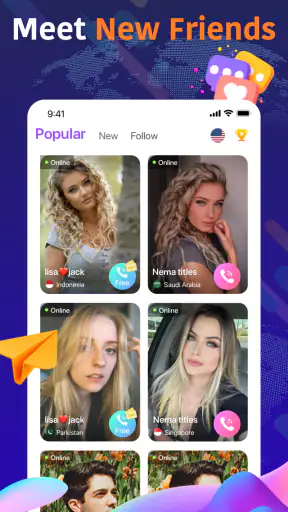
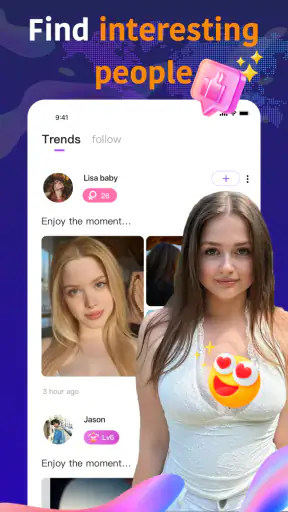
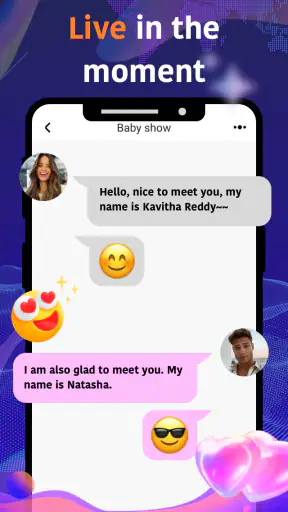
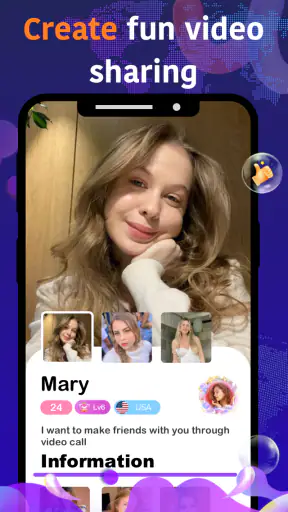
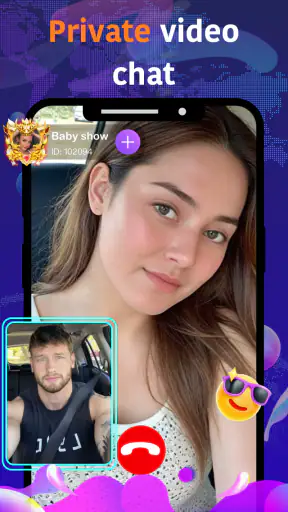
When I opened Olamet, I understood its main appeal quickly: it is built around meeting strangers through online video chat rather than waiting for people I already know to be available. That makes the experience immediate and unpredictable. I can move from a quiet moment to a live conversation without preparing a profile full of posts or building a contact list first.
My overall impression is that Olamet works best as a spontaneous social app. It is free to install, belongs to the social category, and comes from Olamet. Its mature seventeen-plus rating is important because this is not an app I would hand to a child or recommend using casually without thinking about privacy and personal boundaries. The service has reached more than five million installs, while its average rating sits at 4.1 from roughly fifteen thousand ratings, which suggests that the idea clearly attracts people but does not remove the usual uncertainty of stranger chat.
Why live stranger video is the central experience
The defining capability here is the chance to communicate with unfamiliar people through video. That changes the tone compared with ordinary social networks. On a feed-based platform, I usually scroll first, judge a profile, and decide whether to send a message. With Olamet, the social moment can begin much faster. The reward is immediacy: facial expressions, pauses, tone of voice, and the small details that text cannot carry.
That immediacy is also the app’s biggest challenge. A live video conversation asks for more attention than a message. I cannot carefully edit every sentence or inspect a long history before responding. If I am in the mood for quick human contact, this feels lively. If I want a controlled conversation with someone whose interests I already understand, a conventional messaging app or an established community may be a better fit.
I found the capability most useful when I treated it as a short social encounter instead of promising myself a meaningful friendship every time. That mindset matters. Some conversations may be enjoyable for only a few minutes, while others may feel awkward or end quickly. The value comes from the possibility of an unexpected connection, not from a guarantee that every interaction will be memorable.
The app’s store summary presents it as an exciting stranger social app and a video chat service available around the clock. In practical terms, that positioning makes sense for people who want social contact outside their normal circle or schedule. It is less suitable for anyone who dislikes being seen on camera, prefers carefully moderated groups, or wants a predictable way to contact known friends.
What the first conversation feels like
My advice is to enter the first session with a simple purpose. I might want to practice casual conversation, pass time during a break, or meet someone from a different place. Having that small intention prevents the experience from becoming an aimless search for attention. It also gives me an easy opening line and a natural reason to leave when the conversation is not working.
Video makes the interaction feel more personal, but it also exposes more than text does. Lighting, background noise, and the room behind me affect how comfortable the call feels. I would position the phone so that my surroundings reveal as little as possible, use a neutral background, and avoid showing documents, screens, school details, or anything that identifies where I live. This is one of the most practical habits for using a stranger-video service responsibly.
I would also avoid treating a friendly tone as proof of trust. A pleasant conversation can still be only a pleasant conversation. I would not share my full name, address, workplace, private social accounts, financial details, or personal routines during an early call. If someone pressures me for those details, I would end the interaction rather than trying to explain myself repeatedly.
How I would use Olamet in practice
The strongest workflow is short, deliberate, and easy to stop. I would begin when I have enough privacy to pay attention, check that my camera view does not expose sensitive information, and decide how long I want to spend. I would then treat each conversation as a separate encounter rather than assuming that one person represents the entire community.
A useful trick is to prepare three neutral topics before starting: a hobby, a recent film or song, and a general question about daily life. These subjects are safer than asking where someone lives or what they do for work, and they help prevent the silence that can make a live call feel uncomfortable. If the other person responds with equal curiosity, the conversation can develop naturally. If not, I can leave without having disclosed much.
Another practical insight is to use the camera as a boundary rather than an obligation. I would not feel compelled to keep talking simply because a connection has started. If the other person behaves aggressively, asks sexual questions, makes me uncomfortable, or tries to move the conversation elsewhere immediately, ending the call is the correct response. The mature age classification reinforces that this is an adult-oriented environment, not a harmless children’s chatroom.
The app is also easier to judge when I separate technical friction from social friction. A quiet conversation may be caused by poor timing or an incompatible personality, not necessarily a problem with the service. Likewise, an awkward start does not mean every encounter will be poor. I would give the format a few brief tries before deciding, but I would not keep using it if the basic live-video setup itself makes me uneasy.
Keeping control of time, attention, and spending
Olamet is free, but it includes in-app purchases ranging from $0.99 to $104.99 per item. That is a detail I would take seriously before exploring any paid elements. A free download can still lead to optional spending, and live social apps can make users feel that paying will improve their chances of finding better conversations or staying engaged longer.
My approach would be simple: use the free experience first, decide whether the core interaction is genuinely enjoyable, and set a firm spending limit before buying anything. I would never purchase something during an emotionally exciting conversation or because another person encouraged me to do so. If the app’s paid options become central to the experience for me, I would compare that cost with free messaging communities, public interest groups, or video services designed for people I already know.
Time needs the same kind of control. Stranger chat can turn a five-minute break into a much longer session because every new conversation carries the possibility of being interesting. I would use a timer when I have work, study, or sleep to protect. This is not a criticism of the app alone; it is a predictable effect of an unpredictable social format.
The current version is 1.3.2.0 and supports Android 7.0 or later. That makes it accessible to people using older compatible Android devices, although the quality of a video conversation will still depend on the phone’s camera, microphone, connection, and surroundings. I would test the experience in a quiet place before blaming the app for a call that looks or sounds poor.
The everyday situation where it makes most sense
The best scenario I found is a person who has a short period of free time and wants conversation without arranging it in advance. Imagine finishing a late shift, living alone, and wanting a little social contact before going to bed. Friends may be busy, while a text feed may feel passive. Olamet’s live format can provide a more direct sense of company, even if the conversation lasts only briefly.
Another good use is for someone who wants to become more comfortable speaking with unfamiliar people. Because the interactions are live, I can practice introducing myself, asking open questions, listening without interrupting, and ending a conversation politely. I would not describe this as a formal language-learning tool, but the format can still create useful low-stakes speaking practice for an adult who understands the privacy risks.
It can also suit people who find ordinary social feeds exhausting. Instead of constantly posting, reacting, and comparing themselves with others, they can focus on one conversation at a time. That does not make the experience automatically calmer; video can feel more intense than text. Still, for me, the one-to-one immediacy is more purposeful than endless scrolling when I genuinely want interaction.
The app is less convincing for a group of close friends who simply need a reliable video call. In that situation, a familiar messenger is usually better because everyone already knows who is on the other end. It is also not my first choice for professional networking, organized study, dating with detailed preferences, or communities that depend on persistent posts and searchable discussions. Olamet’s strength is spontaneity, not structured relationship-building.
How it compares with familiar alternatives
Compared with text-based social networks, Olamet removes much of the waiting and profile browsing. That can make it feel more human, but it also gives me less time to assess compatibility. Compared with messaging apps for friends, it offers access to strangers rather than dependable contacts. Compared with group video platforms, it emphasizes personal encounters instead of scheduled rooms or shared activities.
Those differences create a clear trade-off. If I value surprise and immediate conversation, Olamet has a reason to exist. If I value control, continuity, moderation I can understand, or a detailed record of someone’s interests, another category of app will probably serve me better. I would choose the tool based on the kind of social experience I want, not simply on whether video is available.
The trade-offs I would consider before installing
The first trade-off is openness versus predictability. Meeting strangers can expose me to perspectives I would not encounter in my normal routine. It can also produce mismatched conversations, unwanted behavior, or abrupt endings. I would see that uncertainty as part of the product rather than an occasional defect.
The second is personal connection versus privacy. Video communicates more than text, which is why it can feel engaging so quickly. It also reveals my face, voice, surroundings, and sometimes my routine. I would use a separate social identity where possible, keep backgrounds private, and avoid moving to another platform until I had a strong reason and enough trust. Even then, I would share gradually.
The third is free access versus optional purchases. The no-cost entry makes experimentation easy, but the range of paid items means I would monitor spending carefully. Anyone who is easily drawn into impulse purchases, or who expects payment to guarantee meaningful conversations, should be especially cautious. Money cannot solve a mismatch in personality or remove the uncertainty of stranger interaction.
There is also a comfort trade-off that is easy to overlook. Some people enjoy being visible and responding in real time; others think better when they can write. If I regularly feel self-conscious on camera, Olamet may turn socializing into work. A text community, voice-only service, or interest-based group could offer a more natural experience.
Small habits that improve the experience
I would start with short sessions and leave room between calls so one uncomfortable interaction does not shape my opinion of the whole app.
I would keep conversation topics broad at first, avoiding exact locations, schedules, family details, and anything that could identify me offline.
I would use a private, uncluttered background and headphones when appropriate, especially if other people are nearby.
I would decide in advance whether I am willing to spend money and never make that decision while a conversation is emotionally intense.
I would stop immediately when a person ignores a boundary instead of trying to rescue the conversation through politeness.
These habits do not make stranger video risk-free, but they make the experience more intentional. The most important insight is that the app rewards selectiveness. I do not need to accept every conversation, answer every question, or continue simply because the other person seems interested. A good session is one where I remain comfortable and in control, whether the call becomes memorable or ends quickly.
Who gets the most from this app
I think Olamet is most appealing to adults who want spontaneous conversation and are comfortable with the social uncertainty that comes with meeting unfamiliar people on camera. It can suit someone who is bored with passive scrolling, wants a quick change of pace, or enjoys practicing casual conversation without arranging a meeting first.
It may also help a socially curious person who understands that not every interaction needs to become a friendship. The app’s value is in access to a live moment. When I use it with realistic expectations, an ordinary evening can include a surprising conversation, a different viewpoint, or simply a brief feeling of connection.
I would skip it if I am under the mature age requirement, if I need tightly controlled communication, or if I am looking for a service centered on existing friends. I would also choose another option if I dislike camera-based interaction, have difficulty setting spending limits, or tend to share personal information quickly with people who appear friendly.
After trying the concept, I see Olamet as a focused social tool rather than an all-purpose communication app. Its developer, Olamet, has made the live stranger-video idea the reason to open it, and that focus is both its attraction and its limitation. I would recommend giving it a careful trial to an adult who wants spontaneous contact, but I would pair that recommendation with firm privacy habits, a spending boundary, and the willingness to leave any conversation that feels wrong.
For me, the final decision is straightforward: choose it for immediacy, not certainty. If the possibility of meeting someone new in a live conversation sounds energizing, the free entry makes exploration easy. If I want dependable contacts, organized communities, or complete control over who can reach me, a more familiar alternative is the wiser choice. The best way to use Olamet is to stay curious without giving up control.


